How to Save Money on a Low Salary in India in 2026: 15 Practical Tips
Saving money on a low salary in India can feel difficult when most of your income goes towards rent, groceries, electricity bills, transportation, EMIs, and family responsibilities. By the end of the month, you may have little or nothing left to save. However, building savings is not only about earning a high salary. It is also about managing your income carefully, controlling unnecessary expenses, and developing consistent financial habits.
Whether you earn ₹10,000, ₹15,000, ₹20,000, ₹25,000, or ₹30,000 per month, you can start improving your financial situation with a realistic plan. You do not need to follow an extreme lifestyle, stop enjoying life, or save a large amount immediately. Even small amounts can help you prepare for unexpected expenses and work towards your future goals.
In this guide, we explain how to save money on a low salary in India in 2026, including practical budgeting methods, ways to reduce monthly expenses, strategies for managing debt, and simple habits that can help you save consistently.
1. Understand Your Monthly Income and Expenses
The first step towards saving money is understanding where your money goes. Many people believe their salary is too small to save, but they may not have a clear picture of their spending habits.
Start by calculating your total monthly take-home income. If you receive a salary after deductions such as provident fund contributions, taxes, or other deductions, use the amount that actually reaches your bank account.
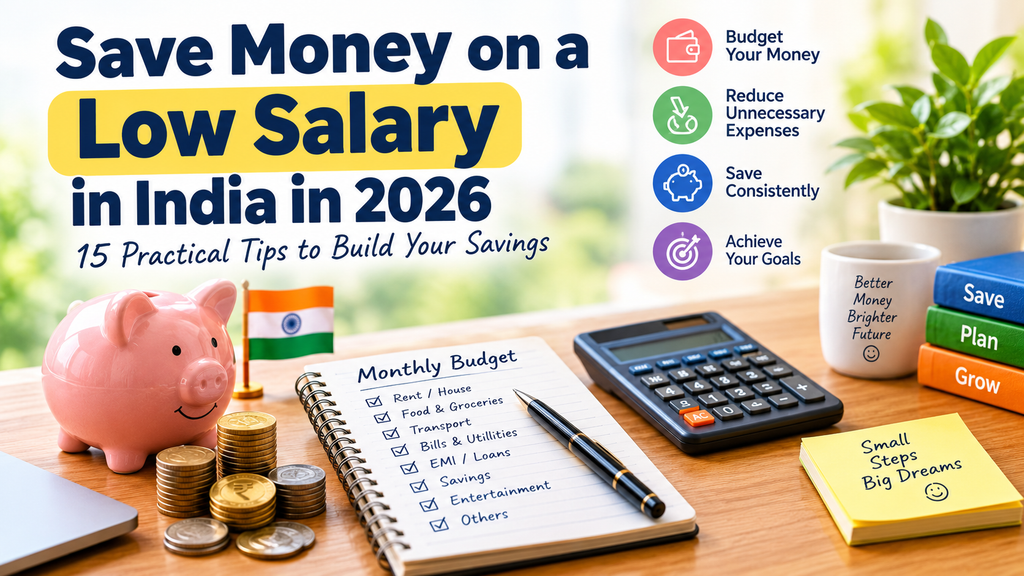
Next, write down your regular expenses.
These may include:
- Rent or housing expenses
- Groceries and household supplies
- Electricity, water, and internet bills
- Mobile recharge
- Transportation and fuel
- School fees or family expenses
- Loan EMIs and credit card payments
- Medical expenses
- Eating out and entertainment
- Shopping and online subscriptions
Review your bank statements, UPI transactions, and cash spending for the previous 30 days. This will help you identify spending patterns that you might otherwise overlook.
For example, spending ₹50 on an unnecessary purchase every day adds up to approximately ₹1,500 over 30 days. You may be able to redirect some of that money towards savings without making a major lifestyle change.
Practical tip: Track your expenses for at least one month before making drastic changes. Your goal is to understand your spending, not to feel guilty about every purchase.
2. Create a Realistic Monthly Budget
A monthly budget helps you decide how to use your salary before you spend it. Without a budget, it is easy to spend too much during the first few weeks and struggle later.
Suppose your monthly take-home salary is ₹20,000. Your budget might look like this:
| Expense category | Monthly amount |
|---|---|
| Rent or household contribution | ₹5,000 |
| Groceries and food | ₹3,500 |
| Transportation | ₹1,500 |
| Electricity, mobile and internet | ₹1,000 |
| Family and personal essentials | ₹2,000 |
| Debt repayment | ₹2,000 |
| Emergency savings | ₹1,000 |
| Other expenses and buffer | ₹4,000 |
| Total | ₹20,000 |
This is only an illustrative budget. Your actual expenses may be higher or lower depending on your city, household size, rent, family responsibilities, and debt obligations.
If your rent alone consumes a large part of your salary, you may need to reduce other flexible expenses or look for ways to increase your income rather than forcing yourself to follow an unrealistic budget.
You can also read our guide on how to create a monthly budget in India in 2026 and add the exact URL of that article once it is published.
The important rule is to make a budget that you can follow every month. A simple, realistic budget is more useful than a complicated plan that you abandon after a few days.
3. Start Saving Immediately After Receiving Your Salary
One of the most effective ways to build savings is to set aside a small amount as soon as your salary arrives.
If you wait until the end of the month, you may spend the money on other things. Instead, decide on a manageable savings amount in advance.
For example:
- ₹500 per month equals ₹6,000 in one year.
- ₹1,000 per month equals ₹12,000 in one year.
- ₹1,500 per month equals ₹18,000 in one year.
- ₹2,000 per month equals ₹24,000 in one year.
These amounts exclude interest and assume that you save consistently without withdrawing the money.
If you earn ₹15,000 per month, starting with ₹300 or ₹500 may be more realistic than trying to save ₹3,000 immediately. Increase the amount when your income improves or you reduce your expenses.
You can transfer the amount to a separate savings account after receiving your salary. If your bank offers suitable automatic transfer facilities, you can use them to make saving more consistent.
However, do not save aggressively at the expense of essential food, housing, medicines, or minimum required debt payments. Your savings target must fit your actual financial situation.
4. Use the 50/30/20 Rule as a Flexible Guide
The 50/30/20 budgeting rule divides your after-tax income into three broad categories:
- 50% for needs
- 30% for wants
- 20% for savings and debt repayment
For a monthly take-home salary of ₹20,000, the guideline would be:
| Category | Percentage | Amount |
|---|---|---|
| Needs | 50% | ₹10,000 |
| Wants | 30% | ₹6,000 |
| Savings and debt repayment | 20% | ₹4,000 |
However, this rule may not work for everyone in India, especially people living in expensive cities or supporting their families on a limited salary.
If your essential expenses already consume 70% or 80% of your income, do not assume that you have failed financially. Start with a smaller savings target, such as 2% to 5% of your income, and increase it gradually.
For example, someone earning ₹15,000 could initially aim to save ₹500 per month. When possible, that person could increase the amount to ₹750 or ₹1,000.
The purpose of a budgeting rule is to help you make decisions, not to force every household into the same percentages.
5. Reduce Food and Grocery Expenses
Food is an essential expense, but poor planning can increase the monthly grocery bill.
You do not need to compromise on nutrition to save money. Instead, focus on reducing waste and unnecessary purchases.
Try these practical methods:
Plan meals in advance. Decide what you will cook during the week and prepare a grocery list before shopping.
Buy according to actual needs. Avoid purchasing large quantities simply because a product appears cheaper per unit. Buying more than you can use may lead to waste.
Compare prices. Check prices at local markets, supermarkets, and trusted online grocery platforms. Consider the final price, including delivery charges.
Cook at home more often. Regular restaurant meals and food delivery can become expensive. Reserve them for occasions when they fit your budget.
Use leftovers safely. Plan meals to use suitable leftover ingredients and store food correctly to avoid spoilage.
Limit impulse purchases. Shopping while hungry or without a list can lead to buying snacks and products you did not plan to purchase.
For example, if reducing food delivery saves you ₹600 per month, that amount could go towards your emergency fund.
The goal is not to make every meal as cheap as possible. It is to get better value from the money you already spend on food.
6. Review Rent and Housing Costs
For many people, housing is the largest monthly expense. If rent takes up a significant portion of your salary, even small savings in other categories may not be enough.
Depending on your circumstances, consider the following options:
- Share accommodation with a trusted roommate.
- Choose a more affordable location if commuting costs remain reasonable.
- Negotiate rent at renewal when appropriate.
- Compare the cost of living alone with sharing a home.
- Avoid paying for unused facilities or unnecessary upgrades.
- Check the full cost of moving before changing accommodation.
For example, moving to a cheaper room might save ₹1,500 in rent but increase transport expenses by ₹1,000. In that case, the actual saving is only ₹500 per month, before considering moving costs.
Always compare the total cost rather than focusing on rent alone.
If you support parents, children, or other family members, housing choices may be limited. Work with the options available to you rather than assuming everyone can move to cheaper accommodation.
7. Control UPI, Online Shopping and Small Daily Expenses
Digital payments make spending convenient, but convenience can also make it harder to notice how much money you are using.
Small purchases can accumulate over time, especially when you use UPI for snacks, delivery fees, subscriptions, transport, and online shopping.
To manage these expenses:
- Check your UPI and bank transactions weekly.
- Set a spending limit for non-essential purchases.
- Remove saved payment details from shopping apps if they encourage impulse buying.
- Avoid purchasing products simply because they are on sale.
- Wait 24 hours before making non-essential purchases.
- Unsubscribe from promotional messages that encourage unnecessary spending.
Suppose you spend ₹30 on an unplanned purchase on five days each week. Over four weeks, that is approximately ₹600.
You do not have to eliminate every small pleasure. Instead, identify the purchases that provide little value and reduce those first.
You can also review our article on UPI safety in 2026 for related digital-payment safety guidance, replacing the homepage link with the published article URL.
8. Reduce Mobile, Internet and Subscription Bills
Recurring expenses may appear small individually, but they continue month after month.
Review your mobile recharge, broadband plan, streaming subscriptions, music apps, cloud storage, and other paid services.
Ask yourself:
- Do I use this service regularly?
- Is a cheaper plan sufficient?
- Am I paying for overlapping services?
- Can I share a family plan where the provider permits it?
- Did I forget to cancel a free trial?
For example, if you cancel two unused subscriptions costing ₹199 each per month, you could save ₹398 monthly or ₹4,776 over a year, assuming the prices remain unchanged.
Compare prepaid and postpaid mobile plans based on your actual data, calling, and usage requirements. Do not switch solely because a plan advertises a lower price; check its validity, benefits, and additional charges.
Review recurring payments at least once every three months.
9. Build an Emergency Fund Before Chasing Bigger Financial Goals
An emergency fund is money kept aside for unexpected but necessary expenses, such as medical bills, urgent repairs, temporary loss of income, or essential travel.
Without emergency savings, a small financial shock may force you to borrow money or use a credit card that you cannot repay in full.
If your salary is low, begin with a modest first target.
A possible progression is:
- Save your first ₹1,000.
- Build the fund to ₹5,000.
- Work towards one month of essential expenses.
- Gradually aim for three to six months of essential expenses, depending on your income stability, family responsibilities, and risk of job loss.
You do not have to reach the final target immediately.
For example, saving ₹500 per month will build ₹6,000 over one year, excluding interest and withdrawals. If you receive extra income, you may be able to reach your target sooner.
Keep emergency money accessible and in a relatively low-risk place appropriate for short-term needs, such as a suitable bank savings account. Review the bank’s terms, access conditions, and applicable deposit protection rules.
An emergency fund is not intended for regular shopping, vacations, or speculative investments. Its purpose is to protect your financial stability when something unexpected happens.
10. Manage Loans and Credit Card Debt Carefully
Debt can make saving difficult because monthly repayments reduce the money available for everyday expenses.
Start by listing each debt, its outstanding balance, interest rate, minimum payment, and due date.
Prioritise paying at least the required amount on every debt. Where possible, direct additional repayments towards high-interest debt first, while maintaining enough cash for essential expenses.
Credit card balances can be particularly expensive when you carry them from month to month. Paying only the minimum due may keep the account from becoming overdue, but it can leave a large balance accruing interest.
Avoid using a new loan to pay an existing loan unless you have carefully compared the total costs, fees, interest rates, and repayment terms.
If you are struggling with repayments, contact your lender early to understand the available options. Do not rely on promises from unverified loan agents or debt-relief services.
You can read our guide on personal loans vs credit card loans for a comparison of borrowing options. Replace this link with the exact article URL before publishing.
Remember that reducing expensive debt can improve your monthly cash flow, but you should not ignore essential living expenses or take on additional risky borrowing in an attempt to save faster.
11. Avoid Lifestyle Inflation When Your Income Increases
Lifestyle inflation happens when your spending increases as your income rises.
For example, if you receive a salary increase of ₹2,000 per month, you might immediately upgrade your phone, eat out more frequently, or purchase additional subscriptions.
As a result, your financial position may not improve despite earning more.
Instead, decide in advance how to use additional income. You might direct part of it towards:
- Building an emergency fund
- Repaying high-interest debt
- Saving for an important upcoming expense
- Investing for suitable long-term goals after considering your financial situation
- Improving essential skills that may increase future earning potential
You can still enjoy some of your salary increase. The idea is to prevent every increase in income from becoming an increase in fixed expenses.
Even a small increase in savings can make a difference when repeated over several years.
12. Find Ways to Increase Your Income
There is a limit to how much you can cut from a low salary. If you already spend carefully and your essential expenses consume most of your income, earning more may be the most effective next step.
Depending on your skills, available time, and local opportunities, consider:
- Learning a skill relevant to better-paying jobs.
- Applying for positions with improved salary or career growth.
- Offering tutoring or coaching in a subject you know well.
- Taking suitable freelance projects.
- Providing design, writing, editing, or technical services.
- Selling legitimate products or services on a small scale.
- Exploring authorised overtime or additional work where practical.
Before paying for a course or business opportunity, check its credibility, total cost, realistic earning potential, and refund terms.
Be cautious of schemes promising guaranteed income, unusually high returns, or easy money for paying an upfront fee. Never share banking passwords, OTPs, or sensitive account credentials with a supposed employer or client.
Also consider the time and expenses involved in earning extra income. A side activity that pays little after transport, equipment, platform fees, or other costs may not be worthwhile.
Increasing your income is not always immediately possible, but improving your skills and exploring realistic opportunities can help over time.
13. Save Windfalls and Irregular Income Wisely
Some people receive money outside their regular salary, such as a bonus, a tax refund, a gift, an incentive, or income from occasional freelance work.
Because this money is not part of the usual monthly salary, it can be tempting to spend all of it immediately.
Before using it, consider your most important financial needs.
For example, you could use an additional ₹5,000 to strengthen your emergency fund, pay down expensive debt, or cover an upcoming essential expense. If those priorities are already under control, you could allocate part of the amount towards a planned purchase or a suitable longer-term goal.
There is no single allocation that works for every person. The right decision depends on your debts, savings, responsibilities, and future needs.
If your income varies each month, prepare your budget around a conservative estimate of what you can reasonably expect to earn. Cover essential expenses first and avoid committing to fixed costs based on an unusually good month.
Treat extra income as an opportunity to improve financial stability rather than money that must be spent immediately.
14. Set Specific and Achievable Savings Goals
Saving becomes easier when you know what the money is for.
Instead of setting a vague goal such as “I want to save more,” choose a specific target with an amount and a time frame.
Examples include:
- Save ₹5,000 for a small emergency fund.
- Save ₹12,000 over one year for an important expense.
- Set aside money for annual insurance premiums.
- Build a fund for education or professional training.
- Save for a necessary household purchase without relying on expensive credit.
Suppose your goal is to save ₹6,000 over 12 months. You need to set aside ₹500 each month, assuming no withdrawals or interest.
Break larger goals into smaller monthly or weekly amounts. Track your progress in a notebook, spreadsheet, or budgeting app.
Keep money intended for different goals separate in your records. This can reduce the temptation to spend emergency savings on a planned purchase.
Review your goals when your circumstances change. If your salary falls or an essential expense increases, adjust the timeline instead of borrowing irresponsibly to meet an unrealistic target.
15. Review Your Progress Every Month
A budget is not something you create once and never check again. Your income, bills, responsibilities, and priorities can change.
At the end of each month, review three things:
Income: How much money did you actually receive?
Expenses: Which categories cost more or less than expected?
Savings: How much did you set aside, and did you need to withdraw any of it?
Identify one or two improvements for the following month. You might reduce delivery spending, switch to a suitable mobile plan, or set up a small automatic transfer to savings.
Avoid making too many changes at once. A few sustainable improvements are usually easier to maintain than a strict plan that makes everyday life difficult.
If you miss your savings target in one month, do not abandon the process. Understand what happened, revise your budget, and start again.
Consistency matters more than achieving a perfect result every month.
Example: How to Save Money on a ₹15,000 Monthly Salary
Consider a person earning ₹15,000 per month who contributes to household expenses and has limited flexibility in their budget.
An illustrative plan could look like this:
| Category | Monthly amount |
|---|---|
| Rent or household contribution | ₹4,000 |
| Groceries and food | ₹3,000 |
| Transportation | ₹1,000 |
| Utilities and mobile | ₹800 |
| Family and personal essentials | ₹2,000 |
| Debt repayments | ₹1,200 |
| Emergency savings | ₹500 |
| Flexible spending and buffer | ₹2,500 |
| Total | ₹15,000 |
This example assumes the person can meet their needs within these amounts. Actual costs may differ significantly, and someone with higher rent, medical expenses, or family obligations may need a different plan.
If the person saves ₹500 monthly, they will accumulate ₹6,000 over 12 months, assuming no withdrawals and excluding interest.
If their expenses later decrease or their income rises, they could increase the monthly contribution. The aim is to establish a habit first and improve it gradually.
Common Money-Saving Mistakes to Avoid
When trying to save on a low salary, avoid these common mistakes:
Setting an unrealistic target. Trying to save too much immediately may leave you short of money for essentials.
Ignoring small expenses. Frequent small purchases can add up, so review your spending regularly.
Cutting essential needs. Do not skip necessary medical care, adequate food, or important bills simply to reach a savings target.
Using credit to maintain a savings balance. Borrowing at a high interest rate while keeping money aside may make your overall financial position worse.
Chasing quick returns. Be wary of investments or schemes promising guaranteed high returns with little or no risk.
Failing to plan for annual expenses. Insurance premiums, school fees, repairs, and festivals can disrupt a budget if you do not prepare for them.
Giving up after one difficult month. An unexpected expense does not mean your savings plan has failed. Reassess and continue when you can.
Comparing your finances with others. Different people have different incomes, responsibilities, and starting points. Focus on improving your own situation.
A Simple 30-Day Plan to Start Saving Money
You do not need to change your entire lifestyle in one day. Use the following plan to begin building better financial habits.
Week 1: Understand your spending
- Write down your monthly take-home income.
- Review bank statements and UPI transactions.
- List fixed expenses, flexible expenses, and debt repayments.
- Identify two unnecessary or avoidable expenses.
Week 2: Create your budget
- Set a realistic monthly savings target.
- Decide how much you can spend on groceries, transport, and entertainment.
- Review recurring subscriptions and mobile plans.
- Plan for upcoming bills and annual expenses.
Week 3: Start saving
- Transfer a manageable amount into a separate savings account.
- Set a first emergency fund target.
- Avoid new unnecessary borrowing.
- Use a spending tracker or notebook.
Week 4: Review and improve
- Compare actual expenses with your budget.
- Calculate how much you saved.
- Identify one more practical way to reduce costs.
- Set next month’s target based on your real results.
At the end of 30 days, you should have a clearer picture of your finances and a practical plan to continue.
Frequently Asked Questions
1. How can I save money on a low salary in India?
Start by tracking your expenses, creating a realistic monthly budget, reducing unnecessary spending, and saving a small amount immediately after receiving your salary. Review your progress every month and increase your savings target when your financial situation allows.
2. How much should I save if I earn ₹10,000 per month?
There is no fixed amount that everyone earning ₹10,000 should save. First, cover essential living expenses and required debt payments. If your budget allows, start with ₹200, ₹300, or ₹500 per month. Increase the amount when you can do so without compromising essential needs.
3. Can I save ₹1,000 per month on a ₹15,000 salary?
It may be possible, depending on rent, family responsibilities, debt, and other essential costs. Review your spending and test whether ₹1,000 fits your budget. If it does not, begin with a smaller amount and work towards increasing it.
4. What is the best way to save money every month?
The most practical approach is to budget your income, automate a manageable savings transfer when possible, reduce unnecessary expenses, and review your progress. The best method is one you can maintain consistently.
5. Should I save money or repay my loans first?
Continue making all required loan payments. If you have no emergency savings, consider building a small financial cushion while prioritising expensive debt, depending on your circumstances. High-interest debt can be costly, so avoid delaying repayments without a plan.
6. Where should I keep my emergency savings?
Choose an accessible, relatively low-risk option suitable for money you may need at short notice. A suitable bank savings account may work for many people. Check the account’s terms, access conditions, and applicable deposit protection arrangements before deciding.
7. How can I reduce monthly expenses without lowering my quality of life?
Focus on expenses that provide little value, such as unused subscriptions, avoidable delivery charges, impulse purchases, or unsuitable service plans. Planning meals, comparing prices, and using a realistic budget can also help without requiring extreme lifestyle changes.
8. Is investing necessary when my salary is low?
Investing can be useful for suitable long-term goals, but your priorities should reflect your financial situation. First consider essential expenses, expensive debt, and emergency savings. Before investing, understand the risks, time horizon, fees, and possibility of losing money.
9. How long does it take to build an emergency fund?
It depends on your monthly savings and target amount. If you save ₹500 per month, you can accumulate ₹6,000 over 12 months, assuming no withdrawals and excluding interest. Increase contributions when your budget allows.
10. What should I do if I cannot save anything from my salary?
Review your essential expenses, debt repayments, and income to understand the shortfall. Look for realistic cost reductions, explore suitable ways to increase income, and seek help from your lender if repayments are becoming unmanageable. If there is genuinely no surplus, focus first on financial stability rather than forcing yourself to save by borrowing more.
Final Thoughts
Saving money on a low salary in India is challenging, but small, consistent steps can help you build better financial habits. You do not need to start with a large amount or follow a perfect budgeting formula.
Understand your income, plan essential expenses, reduce spending that does not add value, and set a savings target that fits your circumstances. Build an emergency fund gradually, manage debt responsibly, and explore realistic opportunities to increase your income.
Most importantly, do not compare your progress with someone else’s financial situation. Your first goal might be saving ₹1,000, while your next goal could be building a fund that covers one month of essential expenses.
Start with what you can manage today, review your progress every month, and adjust your plan as your circumstances change. Consistent financial habits can help you become better prepared for unexpected expenses and future goals.
Important Disclaimer: This article is for educational and informational purposes only and should not be treated as personalised financial, investment, tax, or legal advice. Your financial decisions should be based on your income, expenses, obligations, goals, and risk tolerance. Verify applicable terms and conditions with the relevant bank, lender, or financial institution before making financial decisions.