
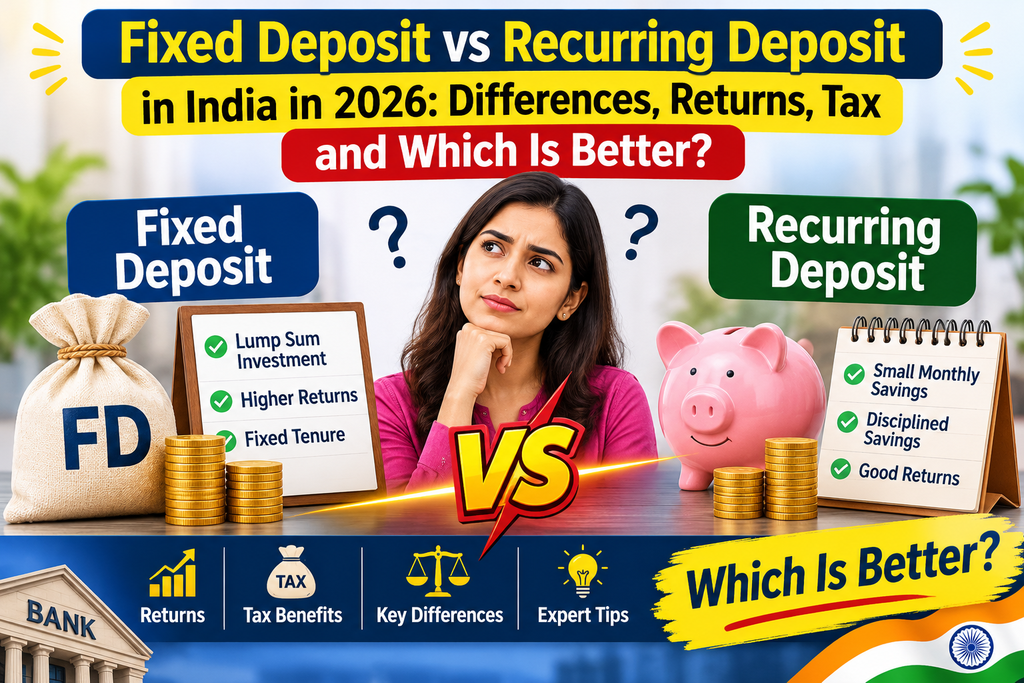
Fixed Deposit vs Recurring Deposit in India in 2026: Differences, Returns, Tax and Which Is Better?
Choosing the right savings option is an important part of managing your money. If you want to save money without taking the market risks associated with stocks or mutual funds, bank deposits may be worth considering. Two popular options in India are Fixed Deposits (FDs) and Recurring Deposits (RDs).
Both options allow you to deposit money with a bank for a specified period and earn interest. However, they work differently. A Fixed Deposit is generally suitable when you already have a lump sum amount to save, whereas a Recurring Deposit is designed for people who want to deposit a fixed amount regularly, usually every month.
For example, if you have ₹50,000 available today, you could consider a Fixed Deposit. But if you can save ₹2,000 from your salary every month, a Recurring Deposit may be more convenient.
Before choosing either option, it is important to understand their differences, interest calculations, tax treatment, withdrawal rules, benefits, and limitations.
In this guide, we explain Fixed Deposit vs Recurring Deposit in India in 2026, with practical examples to help you decide which option may suit your financial goals.
What Is a Fixed Deposit (FD)?
A Fixed Deposit is a type of bank deposit in which you invest a lump sum amount for a selected period at an agreed interest rate.
For example, suppose you have ₹1,00,000 in your savings account and do not need to use it for the next two years. You could place that amount in an FD for the selected tenure.
The bank pays interest according to the deposit’s terms. Depending on the FD type, interest may be paid periodically or added to the deposit and compounded.
Fixed Deposits are offered by many banks in India, including public sector banks, private sector banks, and small finance banks. The available tenures, minimum deposit amounts, interest rates, and withdrawal conditions vary between institutions.
Example:
Suppose you open an FD with ₹50,000 for a selected period. The bank offers an agreed interest rate under its applicable deposit terms. At maturity, you receive the principal amount and the interest payable under those terms, subject to applicable taxes and deductions.
The actual maturity amount depends on the bank’s interest rate, compounding method, deposit tenure, and whether you selected a cumulative or non-cumulative FD.
What Is a Recurring Deposit (RD)?
A Recurring Deposit is a savings option that allows you to deposit a fixed amount at regular intervals, usually every month, for a selected period.
Unlike an FD, you do not need to invest a large amount at the beginning. Instead, you build your deposit gradually through regular contributions.
For example, if you open an RD with a monthly instalment of ₹2,000 for 12 months, you will deposit a total of ₹24,000 during the year, excluding interest.
The bank calculates interest according to the RD’s applicable terms and pays the maturity amount when the deposit completes its tenure.
Recurring Deposits are particularly useful for salaried employees, students, and individuals who prefer saving a small amount regularly.
Example:
Suppose you receive a salary every month and decide to save ₹1,500. You can use an RD to develop a regular saving habit instead of keeping the money in your everyday spending account.
The actual maturity amount depends on the interest rate, instalment dates, tenure, and the bank’s calculation method.
Fixed Deposit vs Recurring Deposit: Key Differences
Although both options are bank deposits, their purpose and working methods are different.
| Feature | Fixed Deposit (FD) | Recurring Deposit (RD) |
|---|---|---|
| Deposit method | One-time lump sum | Regular instalments |
| Suitable for | People with available savings | People saving monthly |
| Initial investment | Usually a lump sum | Usually a smaller monthly amount |
| Interest calculation | Based on deposit amount and tenure | Based on each instalment and its deposit period |
| Deposit frequency | Generally one-time | Generally monthly |
| Tenure | Depends on bank and product | Depends on bank and product |
| Maturity | Principal plus applicable interest | Instalments plus applicable interest |
| Early withdrawal | Subject to bank rules and possible penalty | Subject to bank rules and possible penalty |
| Tax treatment | Interest is generally taxable | Interest is generally taxable |
| Main purpose | Grow an existing lump sum | Build savings gradually |
The biggest difference is the way you deposit money. An FD starts with an amount you already have, while an RD helps you accumulate money through regular contributions.
FD vs RD: Which Gives Higher Returns?
There is no universal answer to whether an FD or RD always gives higher returns. The result depends on several factors, including the amount deposited, interest rate, tenure, compounding method, and timing of each deposit.
A Fixed Deposit starts earning interest on the full lump sum from the beginning of the deposit period, according to its terms.
In an RD, each monthly instalment is deposited at a different time. The first instalment earns interest for a longer period than the final instalment.
This means you should not compare an FD and an RD only by looking at their advertised interest rates. You should compare the actual amount invested, the deposit schedule, the tenure, and the maturity value.
Example: Saving ₹2,000 Every Month
Suppose you have the ability to save ₹2,000 every month for one year.
Your total contribution will be:
₹2,000 × 12 months = ₹24,000.
You could deposit this amount through an RD, where the bank calculates interest on each instalment according to its rules.
Alternatively, if you already have ₹24,000 available at the beginning, you could place the entire amount in an FD for one year.
These two situations are not identical:
- In the RD, you invest money gradually.
- In the FD, the full ₹24,000 starts earning interest from the beginning.
- The FD may generate more interest because the entire amount is deposited earlier, but it requires you to have the full amount available.
For a fair comparison, use the bank’s official FD and RD calculators and compare the maturity amounts for the same overall period and contribution plan.
Do not assume that an RD is automatically better because it allows monthly savings, or that an FD is always better simply because it begins with a larger amount.
How Is FD Interest Calculated?
FD interest depends on the deposit amount, applicable interest rate, tenure, and interest payment or compounding method.
Banks may offer different types of Fixed Deposits.
Cumulative Fixed Deposit: Interest is added to the deposit according to the bank’s compounding schedule. The principal and accumulated interest are paid at maturity, subject to the product terms.
Non-Cumulative Fixed Deposit: Interest is paid periodically, such as monthly, quarterly, half-yearly, or annually, depending on the bank’s options.
A cumulative FD may suit people who want to grow their savings over time. A non-cumulative FD may be useful for people who want periodic interest income.
Before opening an FD, check:
- Whether the interest rate is fixed for the selected tenure.
- How frequently interest is compounded.
- Whether interest is paid monthly, quarterly, or at maturity.
- Whether the bank uses a simple or compound interest calculation for the selected product.
- Whether premature withdrawal is permitted.
- Whether any penalty applies.
Always use the bank’s official calculator for an estimated maturity amount. The amount displayed by a calculator is generally subject to the bank’s terms and applicable taxes.
How Is RD Interest Calculated?
RD interest is calculated on the instalments deposited during the selected period.
Unlike an FD, where the entire amount is deposited at the beginning, RD instalments are added gradually.
For example, consider a 12-month RD with a monthly instalment of ₹1,000.
| Month | Total instalments deposited |
|---|---|
| 1 | ₹1,000 |
| 2 | ₹2,000 |
| 3 | ₹3,000 |
| 4 | ₹4,000 |
| 5 | ₹5,000 |
| 6 | ₹6,000 |
| 7 | ₹7,000 |
| 8 | ₹8,000 |
| 9 | ₹9,000 |
| 10 | ₹10,000 |
| 11 | ₹11,000 |
| 12 | ₹12,000 |
Your total contribution will be ₹12,000, excluding interest.
The first instalment remains deposited for longer than the last instalment. Therefore, each instalment earns interest for a different period.
Banks may calculate RD interest using their applicable compounding and instalment-date rules. Check the bank’s calculator and deposit terms before opening an account.
FD vs RD: Tax Rules in India in 2026
Tax is an important factor when comparing Fixed Deposits and Recurring Deposits.
Many people assume that bank deposits are tax-free because they are considered relatively low-risk savings options. However, interest earned from FDs and RDs is generally taxable under the applicable income-tax rules.
Is FD Interest Taxable?
Yes. Interest earned on a regular bank Fixed Deposit is generally taxable according to the applicable income-tax provisions and your tax situation.
The interest is not automatically tax-free simply because it is earned from a bank.
The tax impact depends on your total taxable income, applicable tax regime, deductions or exemptions available to you, and the rules in force for the relevant tax year.
Is RD Interest Taxable?
Yes. Interest earned on a Recurring Deposit is also generally taxable.
An RD does not become tax-free simply because you deposit a small amount every month.
You should include applicable interest income when reviewing your overall tax position.
What Is TDS on FD and RD Interest?
TDS means Tax Deducted at Source. Banks may deduct TDS from eligible deposit interest when the applicable legal conditions and thresholds are met.
For tax year 2026–27, the Income Tax Department’s published guidance lists the general threshold for interest covered by the relevant bank-deposit TDS provision as:
- ₹50,000 for non-senior citizens.
- ₹1,00,000 for senior citizens.
These thresholds are subject to the applicable provisions and conditions. The bank may consider eligible interest across deposits as required by the rules.
TDS is not necessarily your final tax liability. Your actual tax depends on your total taxable income and applicable tax provisions. If excess TDS has been deducted, you may be eligible to claim a credit or refund through the tax return process, subject to the applicable rules.
Tax rules can change. Always verify the current requirements through the official Income Tax Department website or a qualified tax professional before making a tax decision.
What Happens If You Withdraw an FD or RD Before Maturity?
Before opening a deposit, understand what happens if you need the money before the maturity date.
Unexpected medical expenses, job changes, family responsibilities, or other emergencies may require you to access your savings earlier than planned.
Premature Withdrawal of an FD
Many banks allow premature withdrawal of eligible Fixed Deposits, but conditions vary.
Depending on the bank’s policy, you may receive interest at a rate applicable to the actual period for which the deposit remained with the bank, potentially with an additional penalty.
The final amount may therefore be lower than the maturity amount originally estimated.
Some special deposit products may have different withdrawal restrictions. Always read the terms before investing.
Premature Closure of an RD
Recurring Deposits may also have premature closure conditions.
The bank may calculate interest based on the actual period for which the instalments remained deposited and apply any applicable charges or penalties.
The rules may differ between banks and RD products.
Important: Do not select a long tenure simply because the advertised interest rate looks attractive. Consider when you might need the money and whether you can manage the deposit until maturity.
Are Fixed Deposits and Recurring Deposits Safe?
FDs and RDs offered by eligible insured banks are commonly used for savings because they are not directly linked to daily stock-market movements.
However, it is important to understand the difference between a bank deposit and a government guarantee.
In India, the Deposit Insurance and Credit Guarantee Corporation (DICGC), a wholly owned subsidiary of the Reserve Bank of India, provides deposit insurance for eligible deposits in insured banks.
The insurance limit is up to ₹5 lakh per depositor per insured bank, including principal and interest, held in the same right and same capacity.
This limit covers eligible savings, fixed, current, and recurring deposits together. It is not ₹5 lakh separately for every FD or RD account.
For example, if you hold a savings account, an FD, and an RD with the same insured bank in the same right and capacity, the eligible balances are aggregated for calculating the insurance limit.
Deposits held in different insured banks are considered separately, subject to the applicable rules.
Also remember that DICGC insurance does not cover every type of financial product. For example, mutual funds, stocks, and bonds are not covered by this deposit insurance scheme.
Before opening a deposit, verify that the bank is insured and understand the applicable coverage conditions.
Advantages of Fixed Deposits
Fixed Deposits can be useful for people who already have savings available and want to deposit a lump sum for a selected period.
Some important advantages include:
1. Suitable for lump sum savings
If you receive a bonus, maturity amount, gift, or accumulated savings, an FD can provide a structured way to deposit that money.
2. Interest rate agreed at the time of booking
For a regular fixed-rate FD, the applicable interest rate is generally set according to the bank’s terms when the deposit is opened. This can provide more certainty than products with market-linked returns.
3. Different tenure options
Banks may offer various deposit periods, allowing you to select a tenure based on when you expect to need the money.
4. Flexible interest payment choices
Depending on the bank, you may select cumulative or periodic interest payout options.
5. Useful for planned expenses
An FD can help you set aside money for a future expense, such as education fees, a planned purchase, or an upcoming financial obligation.
Disadvantages of Fixed Deposits
Although FDs have benefits, they also have limitations.
1. Requires a lump sum amount
You need to have the money available at the beginning. This may not be convenient for someone who saves only a small amount from their monthly salary.
2. Premature withdrawal may reduce returns
Closing an FD before maturity may result in reduced interest or a penalty under the bank’s terms.
3. Interest is generally taxable
The tax impact may reduce the amount you ultimately retain.
4. Inflation can affect purchasing power
If the return after tax is lower than inflation, the purchasing power of your money may decline over time.
5. Rates may be less attractive than expected
The return depends on the bank’s current rates and the selected tenure. Do not assume that every FD offers the same rate.
Advantages of Recurring Deposits
Recurring Deposits are particularly useful for people who want to build a savings habit through regular contributions.
1. Encourages monthly saving
You can deposit a fixed amount every month instead of waiting until you have a large amount available.
2. Suitable for salaried individuals
If you receive a salary regularly, an RD can help you set aside a portion of your income.
3. Helps build a savings habit
Regular deposits can encourage financial discipline and reduce unnecessary spending.
4. Lower starting commitment may be available
Some banks offer RDs with relatively small monthly instalments. The minimum amount varies by bank.
5. Useful for short- and medium-term goals
An RD may be suitable for planned expenses, such as an annual insurance premium, education costs, or a household purchase.
Disadvantages of Recurring Deposits
RDs also have limitations that you should consider.
1. Requires regular instalments
You need to make the agreed payments according to the bank’s schedule.
2. Missed payments may have consequences
Some banks may charge penalties or apply other conditions if instalments are delayed or missed. Rules differ between institutions.
3. Interest is earned gradually
Each instalment remains deposited for a different period. The entire target amount does not earn interest from the first month.
4. Premature closure may affect returns
Closing an RD early may lead to a revised interest calculation or applicable penalty.
5. Interest is generally taxable
RD interest is generally taxable under applicable income-tax rules.
FD vs RD: Which Is Better for Salaried Employees?
For salaried employees, the choice depends on whether they already have a lump sum available.
If you receive a monthly salary and can save ₹1,000, ₹2,000, or ₹5,000 regularly, an RD may be more convenient.
It allows you to build savings gradually without waiting until you have a large amount.
However, if you already have a significant amount saved and do not need it immediately, an FD may be worth considering.
Some salaried individuals may use both options for different purposes. For example, they might maintain an emergency fund in an accessible account and use an RD for a planned expense.
The right choice depends on your monthly cash flow, financial responsibilities, and the date when you need the money.
FD vs RD: Which Is Better for Students?
Students who receive a fixed allowance or earn money through part-time work may find an RD useful.
For example, a student who can save ₹500 every month may use an RD to build a fund for books, educational expenses, or a future purchase.
An FD may be more suitable if the student already has a lump sum amount, such as savings received as a gift.
However, students should not lock away all their available money. Keep sufficient funds accessible for education, transport, food, and emergencies.
FD vs RD: Which Is Better for Senior Citizens?
Senior citizens may consider both options depending on whether they want to deposit an existing amount or save regularly.
Some banks offer additional interest rates on eligible deposits for senior citizens. The additional rate, eligibility, deposit limit, and tenure conditions vary by bank.
A non-cumulative FD may be worth considering for someone who wants periodic interest income, subject to the bank’s terms.
An RD may be suitable for a senior citizen who wants to save a regular amount every month.
Before selecting a deposit, compare the interest rate, payout frequency, tax implications, premature withdrawal conditions, and deposit insurance coverage.
Do not choose a deposit only because it advertises a higher senior-citizen interest rate. Check the complete terms.
How to Choose Between FD and RD in 2026
Before opening either account, ask yourself the following questions.
Do I already have a lump sum amount?
If yes, compare suitable FDs. If not, an RD may help you build savings gradually.
Do I want to save every month?
If you receive regular income and prefer monthly contributions, an RD may be more convenient.
When will I need the money?
Choose a tenure that matches your financial goal. Avoid locking money away if you may need it soon.
Do I need regular interest income?
If you want periodic interest payouts, check the non-cumulative FD options offered by banks.
What happens if I withdraw early?
Review premature closure rules and penalties before opening the deposit.
What is the actual maturity amount?
Use the bank’s official calculator. Compare the final estimated amount, not just the advertised rate.
Is the bank insured by DICGC?
Check the bank’s deposit insurance status and understand the ₹5 lakh coverage limit, including the aggregation rules.
Practical Example: Choosing the Right Deposit for Your Goal
Consider three different situations.
Situation 1: You have ₹1 lakh available
You have saved ₹1 lakh and do not expect to need it for the next year. You may compare FD options from insured banks and choose a tenure that matches your financial needs.
Situation 2: You can save ₹2,000 every month
You receive a regular salary and can set aside ₹2,000 after paying essential expenses. An RD may help you accumulate ₹24,000 in contributions over 12 months, excluding interest.
Situation 3: You want both flexibility and planned savings
You have some existing savings and can also save a small amount every month. You may compare an FD for the lump sum and an RD for regular contributions.
These examples are illustrative. The best option depends on the actual interest rate, deposit terms, financial responsibilities, and your need for liquidity.
Common Mistakes to Avoid When Opening an FD or RD
Before choosing a bank deposit, avoid these common mistakes:
Choosing only by interest rate: A higher advertised rate does not automatically mean the best option. Compare tenure, payout terms, penalties, and bank eligibility.
Ignoring premature withdrawal rules: You may need your money earlier than expected. Understand the closure conditions in advance.
Forgetting tax: Interest income may be taxable even if the bank does not deduct TDS.
Depositing all savings in one place: Keep enough money accessible for emergencies and understand the deposit insurance limit.
Missing RD instalments: Check the due dates, payment process, and penalties before opening an RD.
Ignoring inflation: A deposit’s interest rate should be considered alongside inflation and the effect of taxes on your actual return.
Not checking the bank’s official terms: Rates and conditions can change. Always verify the details on the bank’s official website before making a deposit.
Frequently Asked Questions
1. Which is better, FD or RD in India in 2026?
An FD may be better if you already have a lump sum amount to deposit. An RD may be better if you want to save a fixed amount every month. The right choice depends on your income, savings, tenure, and financial goals.
2. Is FD interest higher than RD interest?
Not always. Interest rates depend on the bank, tenure, deposit amount, and product terms. Even if the advertised rates look similar, the actual returns can differ because FD and RD contributions are deposited at different times.
3. Can I open an FD and RD in the same bank?
Yes, eligible customers can generally hold both types of deposits with the same bank, subject to the bank’s account-opening and KYC requirements.
4. Is RD interest taxable in India?
Yes. Interest earned from an RD is generally taxable under the applicable income-tax provisions. The actual tax depends on your overall income and applicable rules.
5. Is FD interest taxable in India?
Yes. Interest earned on a regular bank FD is generally taxable. TDS, where applicable, is only a tax deduction mechanism and does not necessarily represent your final tax liability.
6. Can I withdraw an FD before maturity?
Many banks allow premature withdrawal of eligible FDs, but conditions and penalties may apply. Some products may have restrictions. Check the bank’s terms before opening the deposit.
7. What happens if I miss an RD instalment?
The consequences depend on the bank’s RD policy. Some banks may charge a penalty or apply other conditions. Check the instalment rules before opening the account.
8. Are FD and RD deposits insured in India?
Eligible deposits held in insured banks are covered by DICGC insurance up to ₹5 lakh per depositor per bank, including principal and interest, in the same right and same capacity. Eligible savings, current, fixed, and recurring deposits are aggregated for this limit.
9. Can I open an RD with ₹500 per month?
Some banks offer RDs with a minimum monthly instalment of ₹500, while others may have different minimum amounts. Check the bank’s current product terms.
10. Which deposit is better for monthly savings?
An RD is specifically designed for regular contributions and may be convenient for monthly savings. An FD is generally more suitable when you already have the full amount available.
11. Can senior citizens get higher FD interest rates?
Many banks offer additional interest rates to eligible senior citizens on certain deposits. The extra rate, eligibility, tenure, and deposit limits vary by bank.
12. Is an FD completely risk-free?
An eligible bank FD is not directly exposed to stock-market price movements, but it is not correct to describe every deposit as completely risk-free. Understand the bank’s financial position, deposit terms, withdrawal conditions, and DICGC insurance coverage.
Final Verdict: FD or RD – Which One Should You Choose?
Fixed Deposits and Recurring Deposits can both play a useful role in a savings plan, but they are designed for different situations.
Choose an FD if you already have a lump sum amount and want to deposit it for a selected period. It may also suit people who want a structured interest payout or a maturity amount for a future expense.
Choose an RD if you want to save regularly from your monthly salary or income. It can help you develop financial discipline and gradually build a deposit without needing a large amount at the beginning.
If you have both existing savings and regular monthly surplus, you can consider using both options for different goals.
Before opening either deposit, compare the actual interest rate, maturity amount, tenure, tax treatment, premature withdrawal conditions, and deposit insurance coverage.
The best savings option is not necessarily the one with the highest advertised interest rate. It is the one that fits your financial goals, cash flow, and need for access to your money.
Important Disclaimer: This article is for educational and informational purposes only and should not be treated as personalised financial, investment, tax, or legal advice. Deposit rates, terms, tax provisions, and eligibility conditions may change. Verify all details directly with the relevant bank and official government sources before making a financial decision.
Official Sources and Further Reading
- Reserve Bank of India – FAQs on Interest Rate on Deposits
- Deposit Insurance and Credit Guarantee Corporation – Guide to Deposit Insurance
- Income Tax Department – TDS Rates and Tax Provisions
- Indian Bank – Recurring Deposit Features

How to Create a Monthly Budget in India in 2026: A Step-by-Step Guide
Best Savings Account in India in 2026: How to Choose the Right Bank Account